


A new feasibility moves the conversation from concept to cost, reach and the policy choices ahead.
Economist and urban policy scholar Darrick Hamilton formalized the modern U.S. Baby Bonds proposal with his University of North Carolina graduate advisor and research collaborator, William A. Darity Jr., in 2010. The idea was informed by years of research into the racial wealth gap, intergenerational wealth and the role family resources play in determining who is able to build wealth.
More than a decade later, states are beginning to put versions of the idea into practice. In Colorado, a new feasibility report moves the discussion into specific questions of reach, cost and implementation.
Commissioned by the Colorado Fiscal Institute (CFI) and Soul 2 Soul Sisters (S2SS), the report gives Colorado its first detailed assessment of what a statewide Baby Bonds program could look like.
Researchers with Systems for Equity and Economic Dignity (SEED CO), a research team at the Colorado School of Public Health on the University of Colorado Anschutz Medical Campus, modeled targeted and universal approaches, examined funding and administrative structures and projected how different levels of public investment could affect wealth over time. Led by principal investigator Tran T. Doan, PhD, and researchers Johnny Huynh, PhD, Alyssa M. Hernandez, MA, Corey Jacinto, MPH and Ainsley Buck, MA, the study evaluated several program models to assess their costs, reach, long-term wealth outcomes and feasibility for implementation in Colorado.
Under the primary universal model, one birth cohort could accumulate up to an estimated $1.1 billion in additional wealth by age 35.
Creating a financial starting point
Hamilton had been developing the concept of Baby Bonds for years before formalizing it with Darity. Around 2000, while conducting postdoctoral research at the University of Michigan and participating in Ford Foundation convenings on the racial wealth gap, he studied how family resources and intergenerational transfers shape economic outcomes. That work helped inform an approach centered on public investment for people unlikely to receive capital through family wealth.

During CFI’s Aug. 25 presentation of the findings, Hamilton described Baby Bonds as part of a broader shift from focusing primarily on income to recognizing the role of assets.
“Assets are critical for people to have economic agency in their lives,” he said, distinguishing the approach from savings programs that rely on families having the financial capacity to contribute.
“Income is important, but more than income, the capabilities of having a nest egg, the capabilities to be able to absorb variability or vulnerability in an economic downturn. Having assets should not be the exclusive domain of the wealthy.”
Baby Bonds put that principle into practice through a public investment made on behalf of a child that grows over time and can be used in adulthood for education, homeownership, entrepreneurship and other wealth-building purposes.
Unlike traditional savings programs, the ability to build that asset does not depend on whether a family has enough disposable income to make regular contributions, a distinction central to Hamilton’s argument that unequal savings are often a reflection of unequal resources, not financial knowledge or parental commitment.
“‘It’s not a question of ignorance. It’s not a question of parents not loving their children. It is a resource to save in the first place,” Hamilton said.
Baby Bonds, he added, are intended to “democratize access to assets.’”
From policy concept to public program
Connecticut became the first state to fully fund and implement a publicly funded Baby Bonds program in 2023, investing $3,200 for children whose births are covered by the state’s Medicaid program. An estimated 15,000 to 16,000 infants are automatically enrolled each year, with funds available in adulthood for higher education, job training, homeownership, Connecticut-based business investment or retirement.
By June 2026, California, Connecticut, Vermont and Rhode Island had enacted Baby Bonds programs, while states across the country were pursuing additional proposals, pilots and feasibility studies.
Earlier this year, Colorado joined 11 other states in a national Baby Bonds Community of Practice led by the Institute on Race, Power and Political Economy at The New School and the Urban Institute. Participating states are sharing research and implementation lessons as Baby Bonds policies develop across the country.
What Colorado’s numbers show
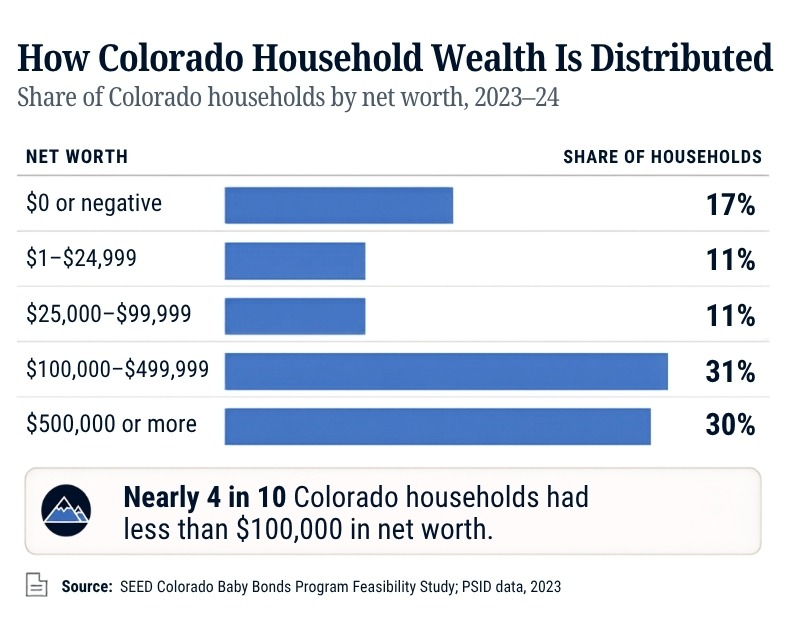
SEED CO’s study estimates Colorado’s median household wealth at $265,600 in 2023-24. Wealth is distributed unevenly across the state, with approximately 17% of Colorado households having zero or negative net worth.
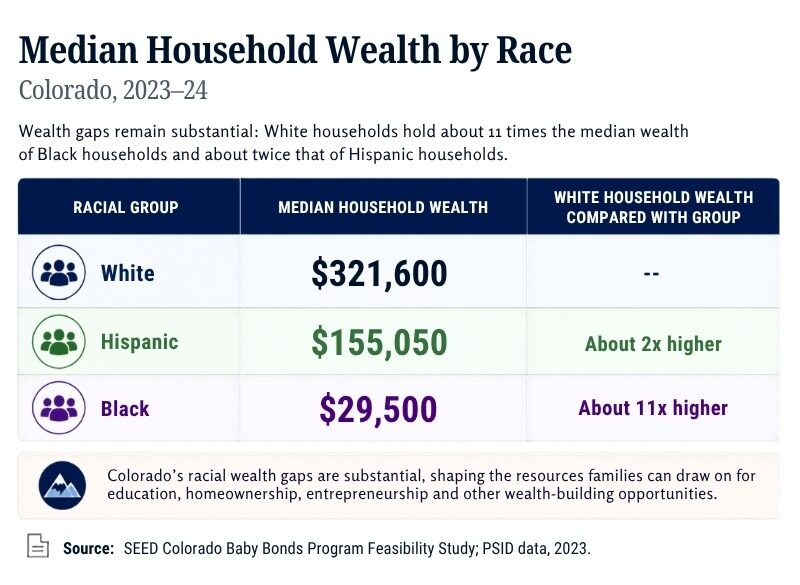
Median household wealth also varied considerably by race, with white households holding approximately 11 times the median wealth of Black households and about twice that of Hispanic households.
The impact of economic disparity extends to children throughout the state. Approximately 11% of Colorado children lived in poverty in 2023, while the poverty rate among toddlers was approximately 13% in 2024. The report identified Costilla, Otero, Crowley, Saguache and Huerfano among the rural counties with some of the state’s highest child poverty rates.
These differences shape the resources young adults can draw on for tuition, a home purchase, business capital and other major investments.
SEED CO’s study modeled how those starting points could change if Colorado created a publicly funded asset at birth.
The long-term value of investment at birth
The study’s primary model assumes Colorado invests $3,200 at birth, makes no additional annual contribution and earns a 5% real annual return. Researchers compared a hypothetical 2026 birth cohort under three conditions. One receives no Baby Bonds; another limits eligibility to children whose births are covered by Medicaid; and the third provides Baby Bonds universally.
The modeled effects become visible by early adulthood.
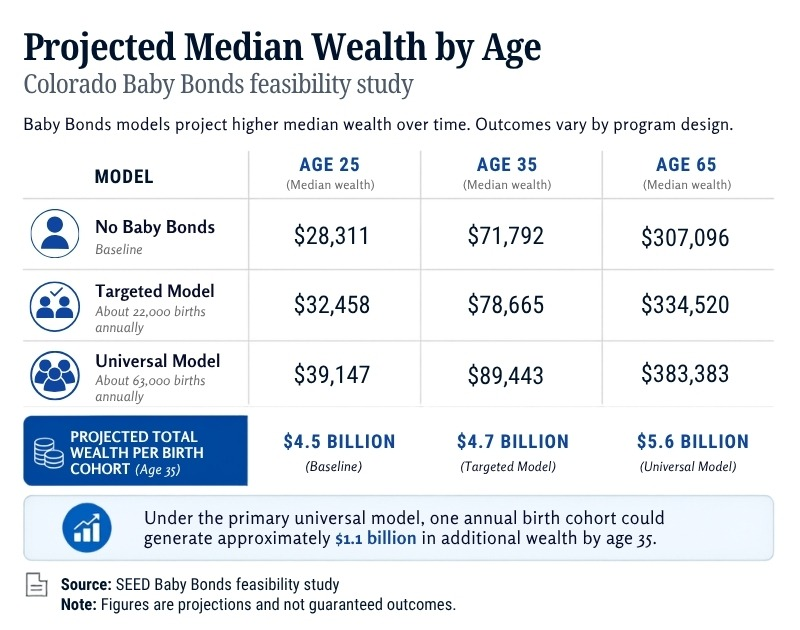
By age 35, projected median wealth rises from $71,792 without Baby Bonds to $78,665 under the targeted model and $89,443 under universal eligibility. Total wealth across the birth cohort increases from approximately $4.5 billion without Baby Bonds to $4.7 billion targeted and $5.6 billion universal.
Across the primary models, universal eligibility produces the largest increase in both projected median wealth and total wealth across the birth cohort.
While the study does not project that Baby Bonds would eliminate existing disparities, it does find substantial changes in how wealth accumulates across groups.
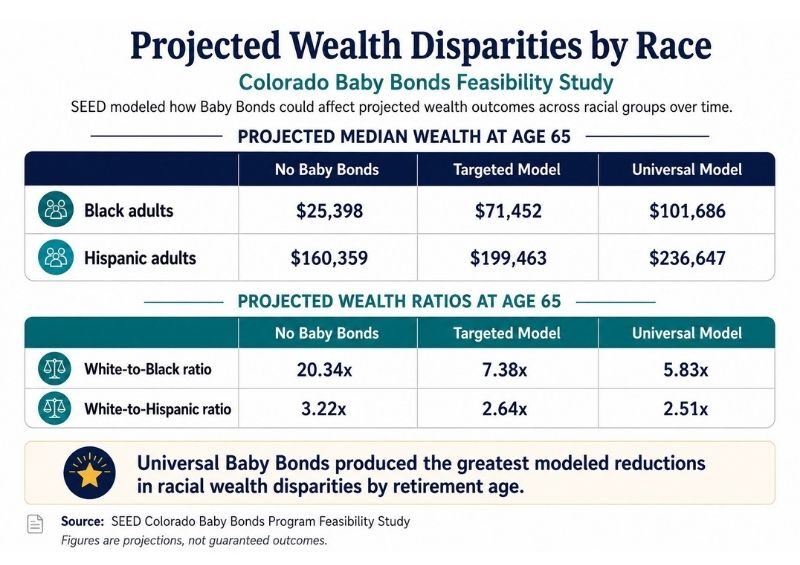
Without intervention, white young adults at age 35 are projected to have approximately 3.09 times the median wealth of Black young adults. That ratio falls to 2.29 under the targeted model and 2.32 under universal Baby Bonds. The white-to-Hispanic ratio falls from 2.02 without intervention to 1.74 under either primary Baby Bonds model.
Baby Bonds narrow specific wealth gaps in the models but do not eliminate wealth inequality. Changes in the Gini coefficient, which measures inequality across an entire population, were modest, leading researchers to conclude that broader reductions would likely require complementary economic policies.
What Colorado’s investment could deliver
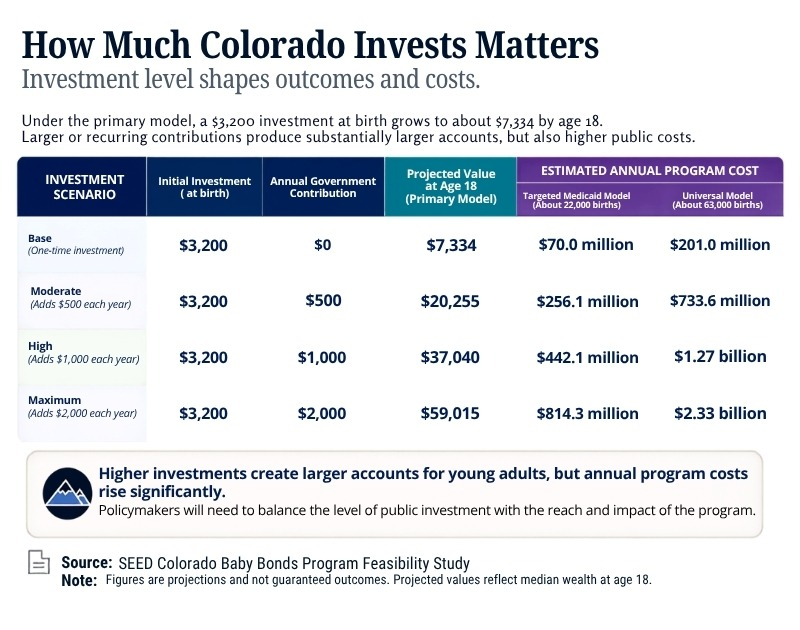
Under the primary model, a $3,200 investment at birth grows to approximately $7,334 by age 18. Larger or recurring contributions produce larger accounts but require substantially greater public investment. Adding $500 annually, for example, raises the projected balance to $20,255 and the estimated annual program cost to $256.1 million targeted or $733.6 million universal.
Baby Bonds eligibility shapes reach
SEED CO modeled several eligibility approaches, ranging from Medicaid-targeted Baby Bonds to broader eligibility and universal coverage. Broader eligibility generally produced larger reductions in projected wealth disparities.
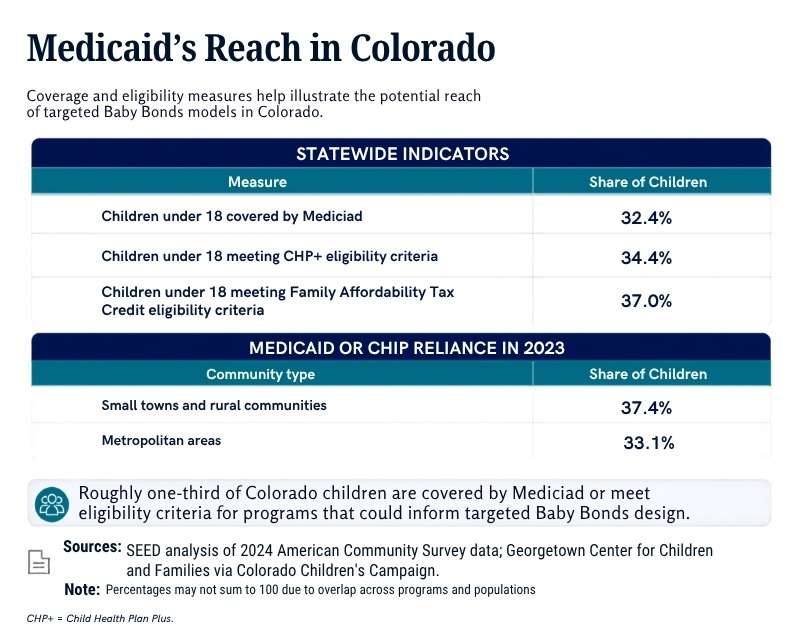
Under the primary $3,200 model, Medicaid-targeted Baby Bonds would reach about 22,000 births each year at an estimated annual cost of $70 million, while universal eligibility would reach roughly 63,000 births at a cost of about $201 million annually.
The report found that universal eligibility would produce the greatest reductions in racial and geographic wealth disparities by retirement age. If universal coverage proves too costly, researchers identified broader targeted eligibility as the strongest alternative.
SEED CO also modeled Section 530A accounts, commonly known as Trump Accounts, and found that they produced the smallest reductions in wealth disparities among the policies examined.
Paying for the program
Identifying program costs is only part of the funding question. Implementers interviewed for the study identified a stable, dedicated source of public funding as the primary implementation and political challenge facing a Colorado Baby Bonds program. They indicated preferences for a structure that would be less vulnerable to annual budget negotiations and changing political priorities.
SEED CO identified several approaches that could contribute to that stability, including dedicated non-tax revenue such as unclaimed property funds, one-time capitalization or an endowment, public-private financing and existing flexible public funds where legally permitted, such as Temporary Assistance for Needy Families (TANF) funds. Researchers identified several approaches Colorado could consider, including one-time capital, dedicated revenue and contributions to entire birth cohorts rather than rely predominantly on annual appropriations.
Other states illustrate how differently that financing can be structured. State Baby Bonds programs and proposals have drawn on general funds, annual appropriations, tax revenue, reserve funds, opioid settlement dollars and unclaimed property funds.
Connecticut remains the clearest example of long-term capitalization. The state transferred approximately $600 million from its Budget Reserve Fund into a dedicated public trust that is expected to finance about 12 years of the program. Because the trust is invested, the structure is intended to generate returns while reducing dependence on new taxes or annual appropriations.
Colorado’s fiscal structure adds another constraint. A new state tax dedicated to Baby Bonds would require voter approval under the Taxpayer’s Bill of Rights (TABOR). The report points to taxes on high-value assets and wealth, including estate and other progressive tax measures, as examples of dedicated revenue approaches used or considered elsewhere, while emphasizing alternatives such as reserve funds and unclaimed property revenue that could reduce reliance on a new tax.
The lifecycle of investment creates another political challenge, with Baby Bonds requiring years of governmental investment before recipients reach adulthood. As lawmakers simultaneously confront demands related to housing, food and family financial stability, a long-term investment model could serve as a hurdle to immediate prioritization.
“People are trying to be responsive to voters of today and not voters of tomorrow,” an implementer said.

Study participants said sustaining political support would require a clear case for public investment, broad community support and an explanation of how Baby Bonds could contribute to Colorado’s longer-term economic future.
Conversely, private dollars could supplement public funding, but the report cautions against allowing those contributions to flow primarily into individual children’s Baby Bonds accounts. Since vastly different family and donor resources could reproduce disparities the program is intended to address, Connecticut’s approach of permitting philanthropic and private contributions to support an entire birth cohort rather than individual beneficiaries could prove beneficial.
From individual assets to economic growth
Study participants pointed to potential effects beyond individual accounts, including workforce retention, homeownership, entrepreneurship, student debt, local economic activity and Colorado’s tax base.
Participants connected the possibilities to ways Baby Bonds could be used in adulthood. Funds directed toward homeownership, business formation or education could help recipients build assets while also supporting local spending, workforce stability and business activity.
“We also see [Baby Bonds] as … a way to retain youth in the state and an economic development tool,” one implementer told researchers.
Researchers note that these broader economic effects are plausible extensions of increased asset ownership, but the study did not separately model statewide economic growth, job creation or tax revenue attributable to Baby Bonds.
The mechanics of implementation
SEED CO notes that Colorado may need one policy action to establish the Baby Bonds structure and another to fund it, with a state agency such as the Colorado State Treasurer’s Office potentially administering a pooled investment fund.
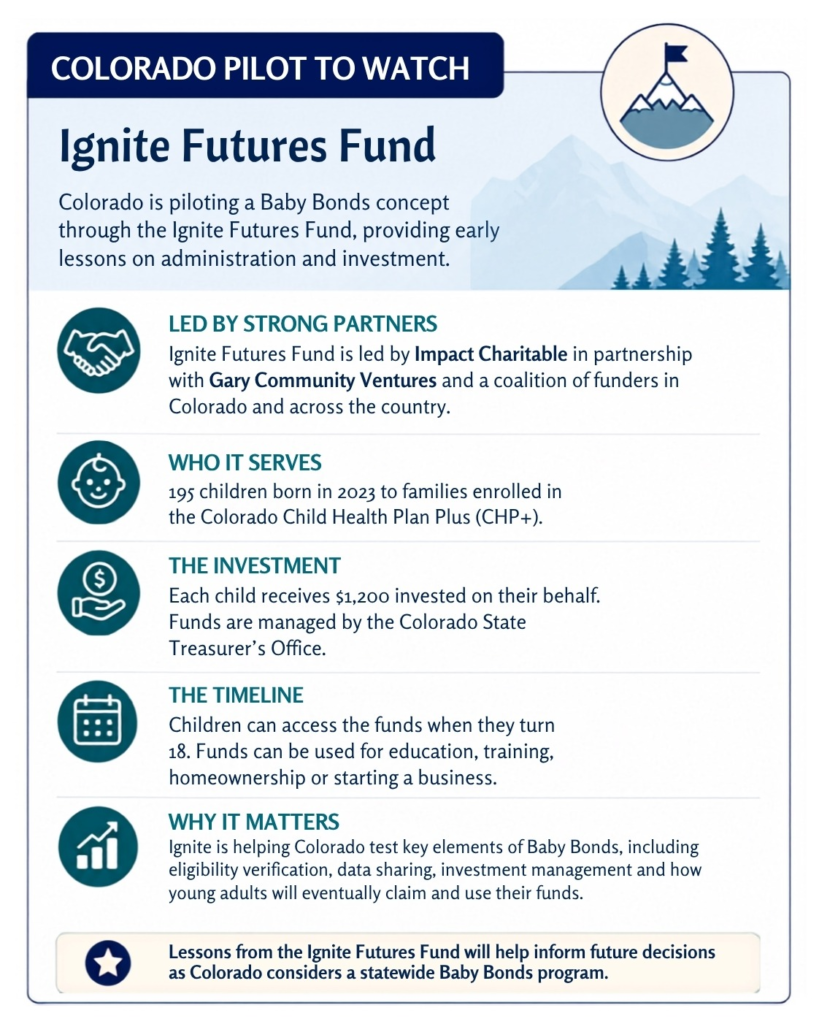
Policymakers would also need rules for eligibility verification, data sharing, investment management, qualified uses and the process for claiming funds.
Financial education is another central component of the proposed program design. Participants in the study consistently identified one-on-one financial coaching as a core part of equitable implementation, with support beginning early, engaging both caregivers and children and preparing young adults to make informed decisions when they eventually access the funds.
Researchers recommend language-accessible resources and partnerships with trusted community organizations, recognizing that financial education is most effective when it reflects families’ circumstances and wealth-building goals.
Importantly, the report does not frame education as a substitute for public investment. Baby Bonds would remain primarily government-funded, while coaching would help families understand their accounts, navigate financial decisions and make effective use of the asset once it becomes available.
The report’s implementation recommendations center on paying funds directly to the young adult recipient and calls for ongoing evaluation and a Community Advisory Board.
The policy decisions ahead
The feasibility study does not create a Baby Bonds program or commit Colorado to a specific level of spending. It provides a framework for evaluating potential models as CFI and S2SS move into the next phase of policy development.
“This is the first step toward developing Baby Bonds legislation and building the broader movement needed to create lasting wealth-building opportunities for Colorado families,” CFI Deputy Director Esther Turcios said when the study was released.
Colorado now has a state-specific basis for evaluating the reach, cost and projected impact of Baby Bonds. The next decisions are political, including whether Colorado pursues a program, who would qualify, how much the state would invest and how the program would be financed and administered.
“We now have the research and the evidence to show the feasibility of Baby Bonds in Colorado,” CFI’s Blair Bacon said at the conclusion of the webinar. “The next step is turning that knowledge into policy and action.”
Editor’s note: To read the final Colorado Baby Bonds Feasibility Report, visit https://coloradofiscal.org/colorado-baby-bonds-feasibility-study/
Watch the full interview on Empower Media Exchange’s “The Exchange” podcast with Esther Turcios here: https://youtu.be/gUVRBD9WxkY
This is the final installment in our series examining Baby Bonds in Colorado. Across the series, we have looked at the economic conditions behind the policy, how Baby Bonds are designed to build assets and what new Colorado-specific research shows about the costs, tradeoffs and decisions that would shape a statewide program.
Read the previous installments: Baby Bonds Could Give Colorado Children a Stronger Financial Starting Point and The Infrastructure Behind Baby Bonds.