


A publicly funded investment at birth could expand young adults’ options for education, homeownership, entrepreneurship and retirement.
For many young adults, the first consequential financial decisions of adulthood arrive before they have the savings, credit history or family resources to make them from a position of stability. Choices about education, housing, transportation, employment and entrepreneurship are often constrained by immediate costs, even when the long-term opportunity is clear. According to the Colorado Fiscal Institute (CFI), a nonprofit organization focused on state tax, budget and economic policies, a Baby Bonds program could change that trajectory for eligible children across Colorado.
To assess how a Baby Bonds program could operate in the state, CFI and Soul 2 Soul Sisters (S2SS) commissioned a feasibility study. The study was conducted by the Systems for Equity and Economic Dignity (SEED CO) research team at the Colorado School of Public Health at the University of Anschutz Medical Campus, led by Dr. Tran Doan, Corey Jacinto, Alyssa Hernandez, Johnny Huynh and Ainsley Buck. It combines policy analysis with perspectives from families, young adults and practitioners.
Without access to capital, young people may begin adulthood by taking on debt or postponing investments that could strengthen their financial security. A student may be accepted into college but have to determine how much debt to assume. An aspiring business owner may have ample experience and a viable idea but no access to startup capital. An early-career professional may be able to manage a monthly mortgage payment but lack the savings required for a down payment.
Talent, ambition and hard work can create opportunity, but access to capital and financial literacy often determines whether young people can translate those qualities into long-term financial stability.
For young adults whose families can contribute to tuition, provide a down payment, co-sign a loan or absorb the unexpected expenses that often arise in early adulthood, major financial decisions can be made from a position of greater security. Without comparable financial support, inherited assets or access to guidance, many young people face more limited choices and greater reliance on debt.
Family wealth shapes the starting point
Baby Bonds are intended to address economic disparities by creating publicly funded accounts for children who begin life with limited family assets. Designed to narrow the intergenerational wealth gap and racial wealth gap, the policy invests public funds into an account at birth and makes them available in adulthood for approved wealth building uses that support education, homeownership, entrepreneurship and long-term financial security.
“Baby Bonds are public trust accounts that the state would hold,” CFI Deputy Director Esther Turcios said, explaining that an initial investment would be made when a baby is born.
The initial investment would grow over time through professional management. Once the recipient reaches the designated age, the funds would be made available for purposes such as postsecondary education, workforce training, homeownership, business development or retirement savings.

Designed to provide access to assets that can influence economic circumstances for decades, Baby Bonds are not intended to provide unrestricted cash. Instead, they are structured to support investments that can increase earnings, create ownership or strengthen long-term financial stability.
Economist Darrick Hamilton, one of the architects of the modern Baby Bonds proposal, has described the policy as a way of “providing people with capital at a key point in their life” so they can acquire an asset that increases in value, according to the Institute on Race, Power and Political Economy.
First proposed by Hamilton in 2010, the concept later gained national attention through federal legislation such as the American Opportunity Accounts Act, introduced by Senator Cory Booker in 2018, and reintroduced by Sen. Booker and U.S. Representative Ayanna Pressley in 2023.
Shan Lagard, who represented S2SS during an earlier interview as its Black civic engagement and policy coordinator, described the program’s potential benefit as giving young people and families greater control over their financial futures.
“It becomes an opportunity for these kids and these families to have choice, actually, in what their futures look like,” Lagard said.
Income vs. wealth
Understanding Baby Bonds requires distinguishing between income and wealth.
Income includes wages, benefits and other recurring money received by a household. Wealth, or net worth, represents the value of a household’s assets after debts and other liabilities are subtracted.
“When we think of income, we think of wages, money you earn for a job that you do,” Turcios summarized. “Wealth is the sum of all of your assets minus your liabilities.”

Income allows families to pay rent, purchase food, cover transportation and meet other recurring expenses. It can also create opportunities to save but is primarily used to support current needs. A household can therefore earn a steady income while still having few assets, limited emergency savings or substantial debt.
“Wealth is your ability to be able to cushion you against a blow, like having an emergency spending need,” Turcios said.
Gary Community Ventures makes a similar distinction in its description of Colorado’s early wealth-building pilot, the Ignite Futures Fund, stating that “wealth, not just income, is the foundation for lasting economic mobility.”
That distinction becomes especially important when young adults encounter opportunities that require an initial investment. Baby Bonds can provide the capital to pursue education, purchase a home, start a business or begin building retirement security without relying as heavily on debt.
Baby Bonds Colorado feasibility study examines policy options
Colorado lawmakers considered a state-led Baby Bonds study in 2024.
House Bill 1297 would have directed the state treasurer to study the feasibility of establishing a program. The proposed research would have examined eligibility, program administration, investment options, funding and other design considerations.
When the bill did not advance, CFI and S2SS moved forward with an independently commissioned feasibility study. The partnership brings together CFI’s fiscal research and policy expertise with S2SS’s experience in civic engagement, economic justice, community advocacy and the relationship between financial stability and health.
The study led by SEED CO uses a mixed-methods approach that includes quantitative modeling, stakeholder interviews and comparative policy analysis.
The quantitative analysis compares potential eligibility structures, investment amounts and projected outcomes under different program designs, while the qualitative research incorporates perspectives from parents, caregivers, agency representatives and young adults.
The study is intended to inform key decisions about eligibility, investment amounts, access to funds, financing and administration. As Colorado weighs those choices, existing programs in other states offer early examples of how Baby Bonds can be structured.
Connecticut offers an early statewide model
Launched in July 2023, Connecticut’s Baby Bonds program is one of the country’s most established statewide models.
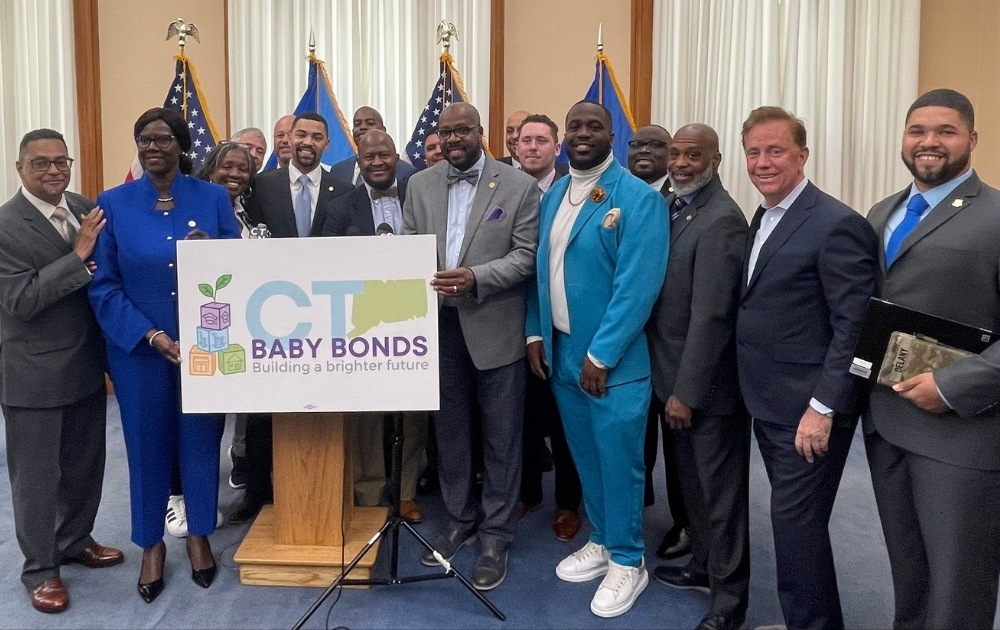
The state invests $3,200 on behalf of each baby born on or after July 1, 2023, whose birth was covered by HUSKY Health, Connecticut’s Medicaid program. Enrollment is automatic and parents do not have to complete a separate application.
Eligible participants must remain Connecticut residents and complete an approved financial literacy course before claiming their share between ages 18 and 30. Approved uses include homeownership, business investment, higher education or workforce training and retirement savings.
Connecticut estimates that the initial investment could grow to between $11,000 and $24,000, depending on when the money is claimed and how investments perform.
Similarly, the amount available under a Colorado program would depend on initial investment, rate of return, age of access, administrative costs and other variables identified during the feasibility study. The model presented by the feasibility study assumes a $3,200 initial contribution, with a 5% annual return, producing a projected balance of $7,334 by age 18.
A Colorado program with statewide reach
One eligibility option under consideration would connect eligibility to Medicaid-covered births, following Connecticut’s approach.
A Medicaid-linked structure could automatically identify eligible children without requiring families to navigate a separate application process. This approach is estimated to cost significantly less than a $200.6 million universal program, at approximately $70 million.
“We have kids from all backgrounds and all races who are born through the state’s Medicaid program,” Turcios said, pointing to the role Medicaid plays in supporting families across the state. “A lot of kids who would be supported would be kids in rural Colorado.”
A statewide program could reach families confronting different economic pressures throughout Colorado’s urban, suburban and rural communities.
Households in metropolitan areas may face high housing and child care costs, while families in rural communities may have fewer nearby options for higher education, employment, transportation and business financing. In either setting, young adults may enter adulthood without the savings, assets or family resources necessary to pursue major financial opportunities.
Baby Bonds were developed in response to unequal access to wealth and disparities created and sustained through public policy and financial systems. In Colorado, a targeted program could reach children across racial, geographic and community lines while directing public investment toward families with the fewest financial resources.

Baby Bonds differ from family-funded savings accounts
Baby Bonds are sometimes compared with 529 college savings plans, custodial investment accounts and newer 530A Accounts, commonly referred to as Trump Accounts. Each involves assets held for children, but they differ in how the accounts are funded and who is positioned to benefit most.
Traditional 529 plans and custodial accounts generally depend on families contributing their own money. Trump Accounts include a limited federal contribution for certain children but may also grow through private deposits. In each case, families with greater disposable income are better positioned to build larger balances.
Baby Bonds place greater emphasis on public investment and automatic enrollment so access to capital does not depend primarily on a family’s ability to save. This structure is designed to create a meaningful financial asset for children whose families may be unable to establish one independently.
The evidence is still developing
Baby Bonds remain an emerging policy, with direct outcome data limited by the years required for investments established in childhood to reach maturity. Even so, several states are implementing, studying or considering related policies, while philanthropic organizations test early wealth-building programs on a smaller scale.
Colorado does not have to wait decades to determine whether the approach is viable. The forthcoming feasibility study will compare potential program models, including how different structures and funding strategies could affect costs, account growth and the number of children reached.
CFI is working closely with Gary Community Ventures to learn from the Ignite Futures Fund pilot. In addition, CFI and other Colorado partners have joined a national Baby Bonds community of practice with organizations and state leaders at different stages of research, policy development and implementation.
“We’re sharing lessons, opportunities, policy, communications, messaging, research and data, and how to involve community in all of this,” Turcios said. “It’s a really great and important opportunity for Colorado to learn from others.”
The research will not determine whether Colorado establishes a Baby Bonds program, but it will move the conversation from a broad policy concept to Colorado-specific evidence. The findings can clarify what a program would cost, whom it could reach and what would be required to give eligible young people greater access to capital, financial guidance and long-term wealth-building opportunities.
For those entering adulthood without comparable family resources, the potential value extends beyond the account balance. It could mean approaching major decisions with more options, less dependence on debt and a stronger sense of what is possible.
“When you’re starting out in life and trying to build wealth and live a good life, it opens up the possibility to dream and ask yourself, ‘What do I want to do with my life?’” Lagard said. “I think it gives people the opportunity to dream.”

About the Colorado Fiscal Institute
The Colorado Fiscal Institute is a nonprofit, nonpartisan organization that conducts research and analysis on the tax, budget and economic policies shaping life in Colorado. Through research, advocacy, strategic communications and partnerships, CFI works to advance responsible, people-centered policies that support working families, strengthen communities and expand economic opportunity across the state.
CFI’s work addresses issues including taxes and TABOR, housing affordability, workers’ rights, environmental justice and the development of a more equitable and sustainable economy. The organization also participates in national networks that connect state-level research and advocacy organizations working to improve fiscal policy and promote broad-based prosperity.
Editor’s note: Learn more about the Colorado Fiscal Institute at coloradofiscal.org and register to attend the upcoming Baby Bonds webinar on Aug. 25 using this link.
Watch the full interview on Empower Media Exchange’s “The Exchange” podcast with Esther Turcios here: https://youtu.be/gUVRBD9WxkY
The next installment in this Baby Bonds Colorado series will examine what Colorado families and researchers say a successful Baby Bonds program would require, including financial education, trusted guidance and support for families’ immediate economic needs.
Comments
One response to “Baby Bonds Could Give Colorado Children a Stronger Financial Starting Point”
[…] Explore the Baby Bonds Community Connections feature from Empower Media Exchange. […]